
 ROSE BRAND
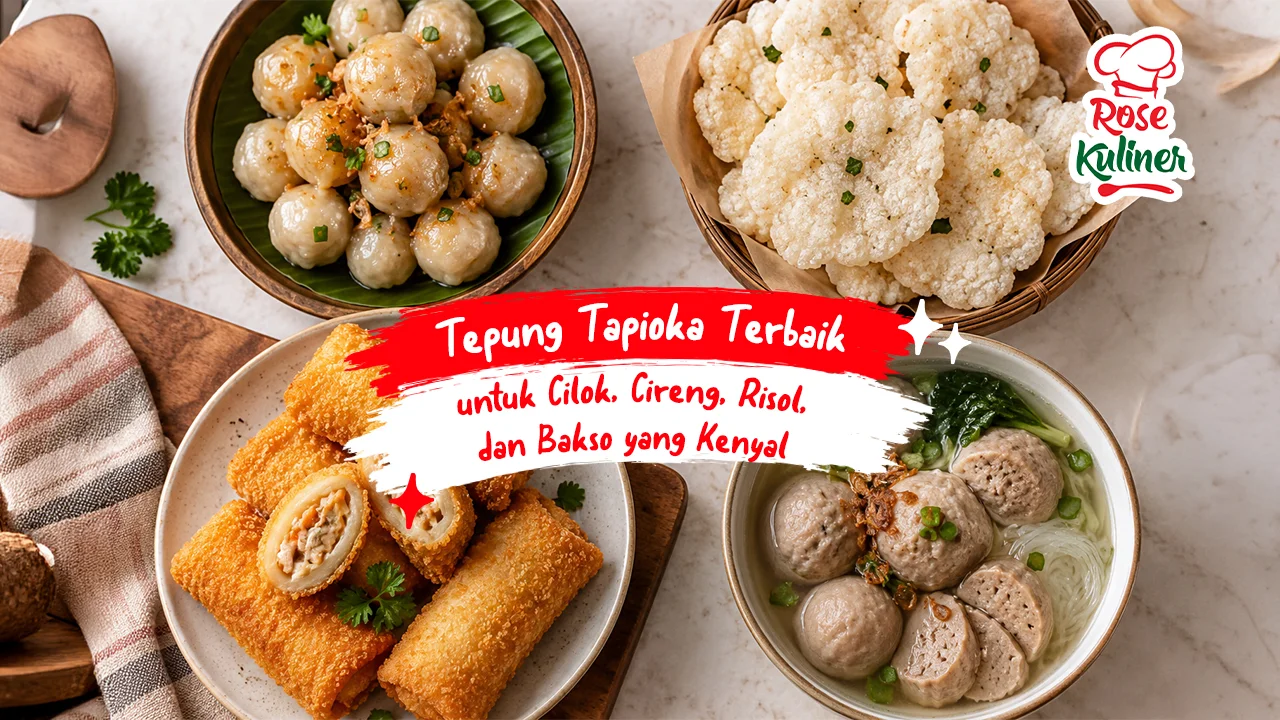
The ingredients of tapioca flour are cassava or yam wood, growing tuberculosis in many parts of Indonesia.
A lot of people have followed the recipe correctly, but the nocturnal result remains hard, the bran of a pillow, and the meatballs are fragile when bitten. Most of the problems don't come from the recipe, they come from the flour. These chewy textures that are characterized are highly dependent on quality and the kind of starch used, and this is where tapioca flour comes in first.
This article speaks in full what is tapestry, quality tapioca flour, used in Cilok, Cireng, Risol, and Bakso, the difference between sago, kanizene, and irrigation, to how to save and choose the best flour for home kitchens and culinary businesses.
What is Tapoka Flour
The tapioca flour is starch that's obtained from tangerine juice. Unlike the wheat flour containing the gluten-shaped protein, tapioca flour is almost entirely composed of pure starch. Therefore, its function is not to build dough structures like bread, it's to give reality, decadence, and a typical slippery texture.
In different areas, this flour is known by different names, and it often raises confusion in the kitchen.
- Kanji Surround: common names are most common in traditional markets, referring to the same material as tapioca flour.
- Aci Flour: popular names in Western Java, also refer to the same singkong starch.
- Tapoca starch: naming in English-speaking packaging or export products.
All three are basically referring to the same material. The difference lies only in naming, not in the raw materials and characters.
Tapoka flour made of What
The tapioca flour is a tapestry (https: / / id.wikipedia.org / wiki / Ubi _ wood) or wooden yams, fat tubs in many parts of Indonesia. Liquor seeds are peeled, washed, then sharpened to smooth to release the grains. The tapestry was then squeezed and dimmed so the starches separated from the fibers and the water.
This sediment of starch is next to being dried up and ground up into fine white powder. In industrial scale production, the whole stage is going on in a closed environment with quality control at every point, so the produce flour is cleaner, drier, and more consistent than the current grain. This consistency is important, because different levels of water will instantly change the reality of Cillok and Bakso that you create.
Quality Tapoka Flour
Before entering your measure and technique, first recognize the flour that is in your hand. Good tapioca flour has a physical character quite easily recognized.
- White and clean, neither gray nor brass.
- It's very delicate and slippery when it's rubbed between the fingers.
- Dry and easy to pour, not clot when pressed.
- It doesn't smell like musty, sour, or stinging cassava.
- It creaks softly when it's squeezed in packs.
- It turns clear and thick like gel when exposed to hot water.
It's the last thing that separates tapioca flour from other flour. Flour of flour will produce murky and dense solution, while tapioca flour turns clear, elastic, and sticky. It's the very nature of the truth in Cillok, Cireng and Bakso.
The benefit of Tapoka's Flour for Cillok, Cireng, Risol, and Bakso
This part is the essence of the problem most often facing catering. Each snack requires a different tapioca proportion, because it also has different texture goals.
Loaded but Not Loud
Cillok relies on tapioca as his main ingredient. But pure tapioca without a mixture produces a hard and arid cilok after cold. The common comparison is two parts of tapioca flour compared to one part of flour, with permeable boiling water poured into it.
The hot water acts to garner some starch before the dough is formed. Without these steps, dough is difficult to pull and Cilok is fragile when boiled. True addons feel a little sticky, but they can still be formed with thin-oil hands.
Cireng with Crispy Skeletons and Inner Medium
Cireng demands much more dominant tapioca proportions, even almost entirely. And the keys of those shall be on the coals, and some of them shall be heated.
It's this technique that makes cieng feel crispy on the outside but keeps your mouth inside. Without the pot, Cireng dough will break in fryer and absorb excessive oil.
Risol with Skin and Easy Rip
In Risol, tapioca flour is not the main ingredient, but the companion. A little amount of tapioca added into a wheat-based skin paste will make the skin more flexible, not easily torn up when rolled up, and not quickly harden after the cold. Besides, tapioca also acts as an ablution of ragout fillings so it doesn't water and it doesn't leak out when fried.
Lumber and not fragrant meatballs
In meatballs, tapioca flour acts as a meat binder and a shape of reality. The proportions must be carefully guarded. Too little makes meatballs fragile and fragile, while too much makes meatballs soar and lose their flesh.
For meatball quality, tapioca is generally used about ten to twenty percent of the meat weight, depending on the desired levels of clarity. Use meat and ice cubes in very cold condition so that emulsions form perfectly before tapioca is inserted. Bakso business workers who need uniform results every day will be greatly helped by tapioca flour with stable water levels, because the prescription measure doesn't need to be changed every time they buy new stock.
Other functions in Kitchen
Beyond all four of these dishes, tapioca flour is also used to create climbers, crackers, bakwana, Boba, and different markets like Ongoongol and Cent. The flour is also used often as a sauce stem and fried flour mix to make it crispy and durable.
Tapiocao-seating and benefits
It's nutritious, tapioca flour is almost entirely carbohydrates in the form of starch, with very low protein, fat and fiber content. According to the nutrition data from USDA FoodData Central (https: / / fc.na.usda.gov /), the tapioca provides high energy but is insignificant as a source of vitamins and minerals.
Nevertheless, this flour has some practical superiority:
- Gluten-free naturally, so it's safe for celiac patients or those who are sensitive to gluten.
- It's easily digested and tends to be lightweight in the hull, so it's often chosen for soft texture foods.
- Giving reality and persistence is hard to replace other flour.
- Neutral in taste, so it doesn't cover the flavors of seasoning or meat.
- It's a rapid energy source because it's high.
It's worth noting that due to the high carbohidrac content and minimal fibers, tapioca flour consumption should be balanced with protein sources, vegetables, and healthy fat. For diabetics, it needs to be controlled as much as any carbohydrate source.
The difference between Tapioka Flour and Other Flanks
The mistake of choosing flour is the cause of the most common failure. Here's the difference you need to understand:
Tapoka and Kanji's flour
They're the same ingredients. Canji flour, aci flour, and tapioca flour refer to identical cassava starch. The only difference is the naming that applies in each of these areas and in the packing label. If a recipe calls kanji flour, you can directly use tapioca flour without any adjustment.
Tapoka and Sagu Flour
This is the most exchanging couple. The sago graft is from the palm of the sagu tree (https: / / id.wikipedia.org / wiki / sagu), not from the cashmere umbi. They're both equal to the starch and produce a chewy texture, but the saws tend to be drier, a little more violent, and absorb more water.
In practice, both are often traded for Plate or Meatball. However, to Cillok and Cireng, tapioca flour generally provides a more blatant result and is not easily hard after the cold.
Tapoka and Maizena Flour
Maizene flour is made of corn starch. They're both the same pure starch and function as a dent, but the results are different. Maizena produces softer, blurred, unelastic nudity, so it's suitable for sauces, vla, and crispy crackers. Maizena can't replace the tapioca on Cillok or Cireng, because it can't produce a talking truth.
Tapoka and Flour Flour
The most fundamental difference. The flour is wheat and gluten, proteins that form elastic structures on bread and noodles. So they could not replace one another. In a lot of recipe, they're combined so textures aren't too loud or too soft.
Tapoka and Rice Flour
The rice flour is made from fine ground rice, not from a silenced starch. The cuisine is thin, mushy, and it's fragile, not chewy. The rice flour is suitable for Talam, Serabi, and Pian, whereas tapioca flour is selected when you want mouth and sticky texture.
General Error creating Cillok, Cireng, and Bakso
Some of the following mistakes occur repeatedly and are easily avoided once you understand the nature of this:
- Using warm water instead of boiling water, so the starch is not ripe and the dough can't be towed.
- Using a hundred percent tapioca without a mixture of wheat in Cillok, so it's hard and hard when it's cold.
- Pass the pronunciation on Cireng, so the dough breaks and is greasy when fried.
- Adding an excessive tapioca to meatballs, so that the taste of meat is gone and the texture feels marooned.
- Cement the dough too long after the starch is ripe, so it becomes too mushy and difficult to form.
- Boil Cillok or meatballs with boiling water too strong, so the surface breaks before it's cooked.
- Using muffled or muttered flour, so the water in the recipe becomes inaccurate.
_
The tapioca flour is very higroscopic, meaning it's easy to absorb water vapor from the air. Therefore, the exact storage determines the consistency of your cooking.
Keep the flour in an airtight container after the packaging is opened, and place it in a dry, cool, as well as away from direct sunlight. Avoid storing it near a stove or a sink, because heat vapor and moisture will make flour clot. In good storage conditions, tapioca flour can last up to a year since the production date.
In order for food security from the Ministry of Health: / / kekes.go.id /), immediately remove the flour if there's any sign of damage such as musty or acidic smell, discoloration into motherness or tanned, hard clumps that can't be broken, or small bugs in packs. For those in large quantities of stock, apply the first in first out for old flour to be used first.
Select the Best Tapoka Flour
The finest tapioca flour is not the cheapest, but the most consistent. Look at the clean white, the fine, dry texture, the sealed packaging without leakage, and the date of production and expiration date clearly listed. Also make sure the product is registered and has official edar permits.
In that case, Rose Brand became a long-time trusted choice in the Indonesian kitchen. As a local brand that has been present for over 45 years, Rose Brand producing tapioca flour through a hygienic process with modern technology, so that levels of subtlety and water levels are preserved uniform from one pack to the next. The sequence of packaging is complete, from small packaging to household needs to large packaging for culinary UMKM users and industrial scale. The product is also easy to get in Shopee, Tokopedia, and Bukadak.
It's the consistency that eventually gives the most real benefit. For the kitchen, you don't have to guess the water measure every time you make a cilok. For Cireng merchants, Bakso, or Centipede, your production will be uniform every day, customers recognize the same texture, and your efforts are spared the loss of a failed dough.